
News
-
Governor and Legislature Reportedly Reach $46B Budget Deal
Short Special Session Immediately Convened
As the Minnesota Legislature reached its mandatory adjournment time of midnight on May 22, lawmakers ran out of time to negotiate and approve budget bills representing about 70 percent of the state’s budget funding.
However, the House and Senate leadership were meeting separately with Gov. Dayton. Less than an hour before midnight, they announced an agreement to immediately convene a special session. That special legislative session is currently considering a tentative deal, reached between the GOP leaders and the DFL governor on a $46 billion two-year budget.
Photo below by Jeff Wheeler, Star Tribune. House Speaker Daudt and Senate Majoity Leader Gazelka announce agreement on budget and special session. House Majority Leader Peppin, Gov. Dayton, and Senate Minority Leader Bakk appear behind Daudt and Gazelka

Written by David Clynes
May 24, 2017 -
Spring Conversation Answers “How are We Doing, With MN Legislative Majority?”
 Great food in a beautiful, relaxed setting and excellent discussions with others from SD49 had all of the attendees prepared to hear from, and interact with, the panel at the Spring Conversation fundraiser May 12.
Our panel of three experts -- Kurt Zellers (former Speaker of the House), Kim Crockett (Executive Vice President, Center of the American Experiment), and David Hann (former Minority Leader of the Senate) - provided political and policy insights as they tackled the first set of key questions posed by moderator & SD49 GOP Co-Chair Randy Sutter: We Republicans elected a majority in both houses of the Minnesota Legislature. The session has a bit more than a week remaining. How are we doing? Have we accomplished enough to satisfy voters? Will we be in a good position for the 2018 races?
The consensus was: given Democrat Governor Dayton’s negotiating style and veto promises (since fulfilled), this Legislative session’s results are likely to disappoint most voters. Voters had high expectations for changes and those won’t happen this session. The negative effects on the next election could be less if the party does better in several areas. These include: communicating the process barriers, setting better expectations, putting longer-term strategies in place, and celebrating the victories that were achieved.
 All panelists noted Governor Dayton’s harsh, even “oddball”, negotiating style, attributed to his lack of experience in typical business win-win negotiations, and his adoption of former DFL Governor Rudy Perpich’s “tantrum” technique. Per Hann, Dayton simply doesn’t know how to negotiate – he doesn’t “get” the concept that both sides need to be happy at the end.
The vetoes are, to some extent, simply for show to satisfy the core DFL base. Despite the messy situation set up by Dayton vetoing ALL the bills sent to him by the House & Senate, the panelists predicted that negotiations would proceed during the final week of the session, and no special session will be needed. (Editor’s note: the panelists did not know that Dayton would delay the start of negotiations, compelling the Republicans to try to rework the vetoed bills on their own. Ultimately, a special session was needed and is being extended on May 24 as we post this.)
Dayton sincerely believes that higher taxes are the solution to fund all his ideas. He has refused to accept or acknowledge studies that show the dire impact on private philanthropy when rising taxes result in higher-wealth individuals leaving the state.
Per Crockett, the Republican majority did their best to anticipate what Dayton would object to and remove those points from the bills; it didn’t help. The Republicans also are “spraying money all over” to try to satisfy Dayton. That included exceeding the automatic spending increases for education, raising the total allocation to $1.1 Billion, even though studies have shown that more money doesn’t improve education results.
Within the Legislature, Crockett noted that the big dynamic is Metro versus Outstate. She predicted that the citizens of Hennepin County (which includes SD49) will be funding light rail. And even though light rail won’t reduce suburban traffic congestion, it could work as a long-term DFL strategic policy to gain legislative seats in the suburbs. The strategy: move the poor to subsidized housing along the light-rail line and they’ll swing those districts to Democrats.
 Audience members posed several additional questions:
 Why do Republicans always give in, and how can that change?
Can you provide an update on the Personal Care Attendants (PCA’s) union lawsuit?
What WILL be accomplished this session?
What more can the Legislature do for health insurance reforms?
Written by David Clynes
May 24, 2017 -
Personal Care Assistants Continue Union Removal Efforts
Attorney Doug Seaton gives us a timeline of the formal steps taken by Personal Care Assistants in the article below, noting that 7,690 election authorization cards have been filed by PCA's in support of the decertification vote. And a formal appeal of Bureau of Mediation Services decisions was filed May 19 with the Minnesota Court of Appeals.
Reporter Kevin Mooney has been following the story and documented further details and the negative side effects the PCA unionization has on real people's lives. You may read his reports from March (CLICK HERE) and May (CLICK HERE).
 The Minnesota PCAs’ Case in the Courts
On May 24, 2013, Governor Mark Dayton (DFL) signed S.F. 778 into law, dramatically changing the lives of home healthcare workers. The law declared that these caretakers were government employees, but only for collective bargaining purposes.
It was an unusual act because these personal care assistants (PCAs) are typically individuals who take care of their family members with disabilities. These PCAs are not traditional government workers in an agency.
Further, the PCAs could not receive the benefits that most government workers receive. All these assistants got was the ability of a union to claim to represent them.
This union was the Service Employees International Union (SEIU), and on August 26, 2016, it declared victory. It was able to win the election with only a majority of the voters, 3,543 out of 5,872, even though there were claimed to be 27,000 PCAs in the group.
In May 2015, the union signed a contract with the state which authorized dues deduction for PCAs of 3 percent of the Medicaid money these PCAs receive for the care of their loved one and a proposed new contract for 2017-2019 continues this procedure.
Written by David Clynes
May 24, 2017 -
May 30 Deadline for Local Candidate Filings is Fast Approaching
Candidates wishing to run for office this year in the cities of Bloomington and Minnetonka have until Tuesday, May 30, at 5 pm to file. Edina and Eden Prairie will not hold mayor or city council elections this year.
 Bloomington voters will elect four city council members this year. To run for the city council, candidates must file with the Bloomington City Clerk’s office. Four municipal offices will be on the ballot and open for filing: Districts 2, 3, 4, and At-Large. Candidates must reside in the district if they wish to run for a district office.
Written by David Clynes
May 24, 2017 -
GOP Legislative Leaders Clear on Objectives Going Into Budget Negotiations
 Republicans who control the MN House and Senate will be asking DFL Gov. Mark Dayton to sign off on a two-year budget worth about $46 billion. Tax increases passed when the DFL held a majority in both houses are now projected to bring in $1.5 billion more than is forecasted to be required to fund the state government in the 2018-2019 biennium if no new spending initiatives were approved. Republicans plan to deliver $1.15 billion of that surplus back to taxpayers in tax cuts or credits.
 While the 2017 Republican budget increases funding to education, it also makes cuts to state government agencies and environmental work. It would provide for significantly less than Dayton wants for schools, transportation, and health and human services.
While DFL legislative leaders see the surplus as funding required to cover vital state government services, Republican leaders see their budget as reflecting the kind of austere approach to spending taxpayer dollars that Minnesotans want.
Written by David Clynes
May 08, 2017 -
Minnesota Legislative Update as of May 1, 2017

A bi-weekly update, compliments of the Public Affairs Office, House Republican Caucus:
-
Budget --Legislative leaders announced joint budget targets on April 28, with a goal respecting taxpayers while investing in key middle-class priorities like tax relief and road and bridge infrastructure. Highlights from the budget target announcement:
- $1.15 billion in tax relief
- $372 million in new funding for road and bridge infrastructure
- $1.14 billion in new funding for K-12 schools over the current biennium
- an overall budget target that ensures a sustainable level of state spending for the next biennium
Lawmakers met the April 28th deadline requested by Governor Dayton in a letter to the legislature this March. Although Gov. Dayton subsequently backed away from his deadline, legislators decided to honor the Governor’s request by agreeing to one set of budget targets to reflect the position of the legislature.
-
Public Budget Negotiations -- By the end of April, Conference committee members had already been meeting for two weeks. They had repeatedly urged Governor Dayton and his commissioners to engage and begin negotiating compromises, to no avail. On April 28, Speaker Daudt and Senate Majority Leader Gazelka publicly requested all three parties (Governor, Senate and House) come to the table and reach agreement on three-way budget targets by Thursday, May 4th.
Written by David Clynes
May 08, 2017 -
-
MN GOP State Central Meeting Elects New State Officers
Minnesota Republicans held a meeting of the State Central committee to elect new officers in Saint Cloud on Saturday, April 29. There was great anticipation leading up to the meeting with 4 candidates for Chair, 3 candidates for Deputy Chair and our own Barb Sutter running opposed for Secretary.
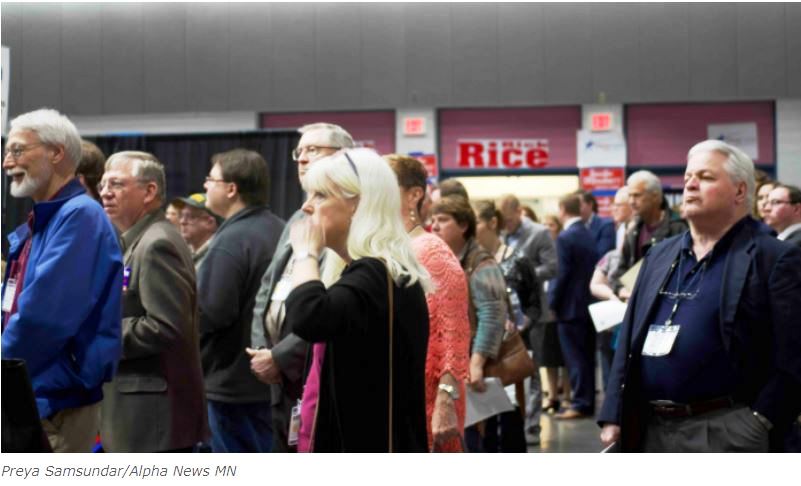 Almost 800 delegates and alternates showed up, of which 338 were designated to vote for the candidates. Great credit goes to the four (4) delegates and 12 alternates from Senate District 49 for their commitment. All but one of these representatives registered and came to the meeting ready to serve. Attendance exceeded expectations, and for much of the meeting, it was standing-room only.
There were many key speakers that talked about the importance of the next election for governor and the need for all republicans to volunteer to support the party to be successful. Tom Emmer and Jason Lewis came from Washington D.C. to tell of the changes being made as a result of the last election. Kurt Daudt, Speaker of the House, and Paul Gazelka, the Senate Majority leader, gave us an update from the capitol, the challenges of working with Governor Dayton, and the importance of electing a Republican governor in 2018. That set the stage for the voting.
Written by David Clynes
May 08, 2017 -
Congratulations to Jennifer Carnahan as New MN GOP Chair
 Jennifer Carnahan surged through four ballots to capture a majority of the voting members of the MN GOP State Central meeting, held on Saturday, April 29. As reported by Alpha News MN, Carnahan became the second female and the first minority to be elected chair of a major political party in Minnesota.
 The delegates were clearly touched by Carnahan’s background story of being abandoned as a baby on the rear steps of a Korean hospital. She gave great credit to her parents, who adopted her and brought her to Minnesota. Carnahan pointed out that she is an example of what can be achieved in America. “If I could dream it, I could live it.” She stated that she is proud to be an American Citizen and proud to be a lifelong Republican.
Written by David Clynes
May 08, 2017 -
Samsundar Finds Opportunities, Rewards in Writing for Alpha News
Our April dinner speaker, Preya Samsundar, experienced an action-packed first year as a professional journalist. On her way to an undergraduate degree a year ago at University of Minnesota, expecting to soon take the LSAT exam and apply to Law Schools, she accepted an opportunity presented to her: write for a start-up online news organization, Alpha News. She found the work so interesting she completed her double-degree in Political Science & Sociology with an added minor in Journalism. She now writes for The Hill as well as Alpha News.
 In summer of 2016, Samsundar’s editor asked her to look into a mention in the Powerline Blog that a Somali woman candidate running for the DFL endorsement against long-time Minnesota state representative Phyllis Khan (District 60B) had two husbands. Samsundar dug deeply into the story of Ilhan Omar’s deceptions and found herself spotlighted at the national level by Fox News. Her own background as the daughter of immigrants (her parents both came, legally, from South America) was a key factor in her reaction that something was “off” about Omar’s angry and evasive responses to questions about her family / marital status.
 Starting to unravel the threads, Samsundar found the candidate had TWO marriage certificates, the first of them to her brother while she was still in college, and 3 children by her second “cultural husband”. During the election campaign the candidate said she was “in the process of getting a divorce” but now that she’s in office she is not proceeding. She cites costs & difficulties in gaining consent, even though MN grants divorce when petitioned by one person. Omar’s brother/”husband” living in London, whom Samsundar interviewed during the campaign, still has access to the USA as the spouse of a US citizen.
A video excerpt of Preya Samsundar speaking at the SD49 Dinner Meeting is viewable here
https://www.youtube.com/watch?v=vz-lZ2zu-tI&feature=youtu.be
Written by David Clynes
May 08, 2017 -
Blake Huffman Launches Campaign for Governor
 It is official. Blake Huffman, the first candidate with electoral experience to seek endorsement from the Republican Party in the race for Minnesota’s next Governor has officially declared his intentions.
Huffman, 52, is coming off a recent successful reelection campaign for his seat as Ramsey County Commissioner, District 1. Huffman was first elected in November 2012 after retiring from Wells Fargo as Vice President of Strategy.
Huffman’s campaign website indicates his focus will be on jobs and the economy, housing, education, and most importantly, his ability to get things done.
Jobs and Economy: In an April 19 press conference (video) to announce his candidacy, Huffman asserted his, “primary focus is supporting private sector job growth.” He pointed out that while Minnesota’s official unemployment rate is low; the under-employment rate was, “far too high.”
For comparison, the U.S. Department of Labor reported Minnesota’s unemployment rate in 2016 at approximately 4.0%. Meanwhile, the United Health Foundation estimated that Minnesota’s under-employment rate was double that, at 8.2%.
Housing: According to Huffman’s campaign website, he believes, “one of the foundations of a great community is providing citizens with stable housing and a place they can call home.”
Written by David Clynes
April 24, 2017